California's AB 2533 gives owners of unpermitted ADUs and junior ADUs built before January 1, 2020 a real path to a permit — no impact fees, no penalties, and no denial over setbacks or unit size. Here is what the law says, who it covers, and where it stops.
- ▸AB 2533 took effect January 1, 2025 and amended Government Code Section 66332
- ▸It covers unpermitted ADUs and JADUs constructed before January 1, 2020
- ▸A city cannot deny the permit over setbacks, size, parking, or ADU-ordinance rules
- ▸It can deny over health and safety — the Health & Safety Code Section 17920.3 test
- ▸No impact fees or connection charges, with one narrow utility-infrastructure exception
- ▸Process and paperwork vary by city; your building department makes the final call
If you own a home in Orange County with a garage that became a studio, a back house that was never on a permit, or a bedroom that quietly acquired its own kitchenette and entrance, you have probably done the math on legalizing it and decided the risk was not worth it. For years that was a defensible read. Applying meant volunteering your address to a code-enforcement file, and the rules you would be judged against were the same rules that govern a brand-new ADU — setbacks, unit size, parking, lot coverage — which an improvised conversion almost never meets.
AB 2533 changed that math. Here is what the law actually says, who it reaches, what it does not do, and how the process generally runs in a county where every city runs its own building counter.
What AB 2533 changed
AB 2533 was authored by Assemblymember Juan Carrillo, approved by the Governor on September 28, 2024, and chaptered as Chapter 834 of the Statutes of 2024. As a standard non-urgency measure it took effect January 1, 2025. It amended Section 66332 of the California Government Code — the section that governs permits for unpermitted accessory dwelling units.
There was already an amnesty on the books before AB 2533, but it was narrow. It reached only accessory dwelling units constructed before January 1, 2018, and it said nothing at all about junior accessory dwelling units. AB 2533 did two consequential things: it moved the construction cutoff forward to January 1, 2020, and it brought JADUs inside the protection. It also added a public-information duty, which turns out to matter more than it sounds like it should — more on that below.
The core of the statute is subdivision (a). A local agency shall not deny a permit for an unpermitted ADU or JADU constructed before January 1, 2020 because the unit is in violation of building standards, or because it does not comply with state ADU law or the city's own ADU ordinance. That second clause is the one that unlocks most real-world conversions. The reason your garage studio would fail as a new-build application — it sits on the property line, it eliminated a required parking space, it is larger or smaller than the ordinance allows — is no longer a lawful basis for denial.
Who the law covers
Three conditions have to hold. Two you can answer yourself; the third is the one worth spending money to find out.
- Constructed before January 1, 2020. This is a hard statutory line, not a guideline. A unit finished in 2020 or later is outside AB 2533 entirely, no matter how well built it is. Permit records, satellite imagery history, dated photos, contractor invoices, and old listing photos are all evidence of when a conversion happened.
- An ADU or a JADU. Both are covered. State law defines a junior accessory dwelling unit as a unit of no more than 500 square feet created within the walls of a single-family home — the converted-bedroom-with-its-own-entrance case. A detached back house or a converted detached garage is an ADU.
- Not substandard under Health & Safety Code Section 17920.3. This is the condition test, and it decides everything. It is described in the next section.
The condition test is the whole ballgame
AB 2533 is generous about rules and unforgiving about safety, and that trade is deliberate. Two subdivisions carry it. Subdivision (b) allows a local agency to deny the permit if it finds that correcting a violation is necessary to comply with the standards in Health & Safety Code Section 17920.3. Subdivision (c) goes further: the section does not apply at all to a building deemed substandard under that same code.
Section 17920.3 is California's statutory definition of a substandard building. It is a long list, and it sorts into groups that any inspector will recognize immediately:
- Inadequate sanitation — no proper toilet, sink, tub or shower; no hot and cold running water; inadequate heating or ventilation; insufficient natural light; rooms below required dimensions; dampness in habitable rooms; visible mold growth; no connection to the required sewage disposal system.
- Structural hazards — deteriorated or inadequate foundations, faulty flooring or supports, insufficient load-bearing capacity, cracked or leaning walls, sagging roof members, defective chimneys.
- Hazardous electrical wiring — wiring that does not conform and is not being used in a safe manner. In an unpermitted conversion this is close to universal.
- Hazardous plumbing and mechanical equipment — plumbing not maintained in good and sanitary condition or containing cross-connections; mechanical equipment and vents not properly maintained.
- Fire hazards and inadequate exits — conditions creating a fire or explosion risk, buildings without adequate exit facilities, and missing or insufficient fire-resistive construction or fire-extinguishing equipment.
- Faulty weather protection and materials — deteriorated exterior coverings, failed waterproofing, broken windows or doors, and materials of construction not of approved type or not adequately maintained.
Read that list next to a typical 1970s Orange County garage conversion and the pattern is obvious. The things most likely to go wrong are electrical, egress, and drainage — extension-cord-grade wiring buried in a finished wall, a bedroom with no window that opens to the outside, a shower drain tied into something that was never meant to carry waste. Those are also the findings most likely to be invisible from the doorway and expensive once opened.
What the law protects you from
Once you do apply, Section 66332 is written to keep the process from turning punitive. Subdivision (e) provides that a homeowner applying to permit a previously unpermitted ADU or JADU built before January 1, 2020 shall not be required to pay impact fees or connection or capacity charges — with one narrow exception, where utility infrastructure has to be upgraded to comply with Section 17920.3. On a project where a sewer lateral or a service upgrade is in play, that exception is real money, which is another argument for knowing the condition before you file.
Subdivision (f) is the one that answers the fear most homeowners actually have. It says that on receiving an application, a local inspector may inspect the unit for compliance with health and safety standards and provide recommendations, and that if the inspector finds noncompliance, the local agency shall not penalize the applicant for having had the unpermitted unit and shall approve the permits necessary to correct it. The statute is pointing the process toward a fix, not a fine.
And subdivision (d) requires every local agency to publicize all of this — through permit checklists and its own website — including a checklist of the Section 17920.3 conditions that would deem a building substandard, and a notice to homeowners that before submitting an application they may obtain a confidential third-party code inspection to determine the unit's existing condition and the likely scope of improvements. The Legislature built a look-before-you-leap step into the statute itself.
How the process generally runs
The sequence below is the common shape of an AB 2533 legalization. Treat it as orientation, not as your city's checklist — that part genuinely varies, and your building department is the authority on its own process.
- Establish the build date. Assemble whatever proves the unit existed before January 1, 2020. Without this, nothing else matters.
- Get an independent condition inspection. Find out what you are dealing with while every option is still open. This is the step the statute itself tells cities to tell you about.
- Read your city's AB 2533 materials. Under subdivision (d) the checklist and process information should be published. Some Orange County jurisdictions have detailed handouts; others have very little, in which case call the counter and ask.
- Get drawings and a scope. Most legalizations need as-built plans, and any corrective work needs a licensed contractor. What the inspection found determines how big this step is.
- Submit the permit application for the existing unit plus the corrective work, and go through plan check.
- Do the work and pass inspections, including any work opened up for verification, and receive final sign-off.
What to prepare before you start
- Evidence of the construction date — old photos, permits on other work, listing history, aerial imagery, invoices.
- The property's permit history from the city, which often reveals what was and was not ever recorded.
- Any documentation on the systems serving the unit: panel upgrades, re-pipes, water heater installs, sewer work.
- A realistic contingency budget. AB 2533 removes fees and denial grounds; it does not remove the cost of correcting a genuine hazard.
- A clear-eyed answer to what you want the unit to be afterward — rented, family housing, or simply legal on paper before a sale.
Why a local inspector matters
AB 2533 is uniform state law, but the permit is issued by a specific building department with its own plan-check culture, its own handouts, and its own timeline. Anaheim, Santa Ana, Irvine, Huntington Beach and Orange are five different counters. An inspector who works Orange County every week is reading your unit with that context in the room.
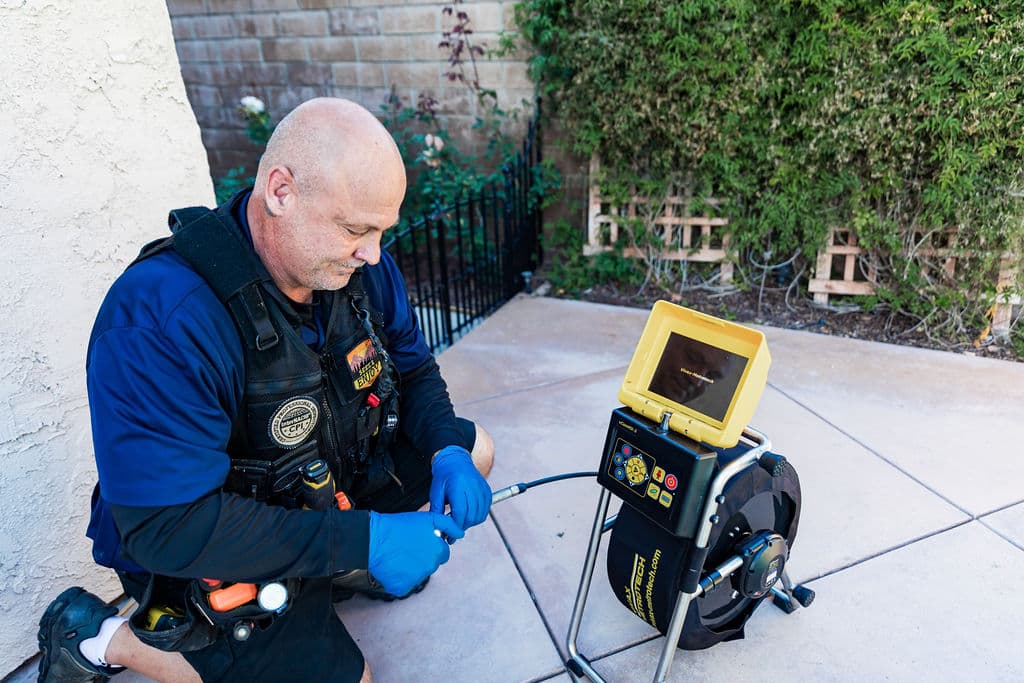
There is also a practical point about scope. Several of the Section 17920.3 categories map directly onto specialized inspections rather than a glance around the room. Drainage and "lack of connection to required sewage disposal system" is a sewer scope question. Dampness in habitable rooms and visible mold growth — both named in the statute — is a mold and indoor air quality question. Deteriorated structural members in a decades-old conversion frequently turn out to be a wood-destroying-organism question, which is what a termite inspection is for. A general condition report should tell you which of those, if any, you actually need.
What AB 2533 does not do
It does not make an unpermitted unit legal by itself — you still apply for and receive a permit. It does not reach units built on or after January 1, 2020. It does not override the Section 17920.3 condition test, which is the specific thing it preserves. It does not guarantee approval of your particular application; your building department makes that call on your specific unit. And nothing here is legal advice — for that, talk to your building department or a land-use attorney.
Thinking about legalizing a unit in Orange County? Start with an independent report on where it actually stands. See our AB 2533 ADU legalization inspections, or read what to expect during the inspection itself. For the property as a whole, a standard home inspection covers the main house alongside it.